AI Impact Summit: Event Optics or Strategic Transformation?
A Critical Perspective
By Advocate Amaresh Krishna
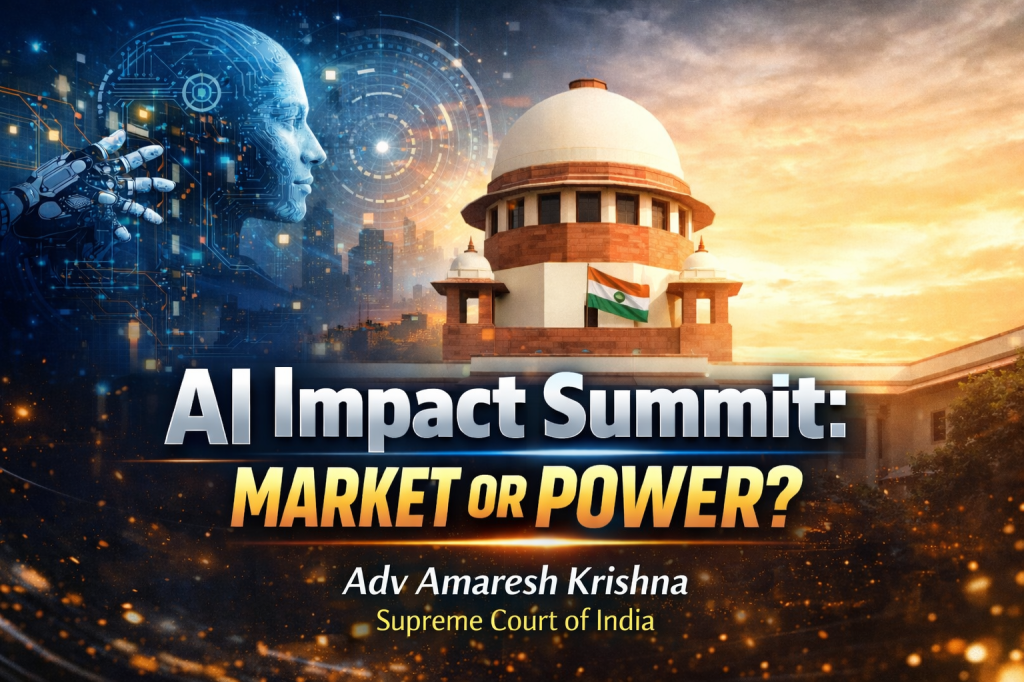
Artificial Intelligence is no longer a futuristic ambition; it is a present strategic reality shaping geopolitics, economics, governance, and national security. In this context, the recently concluded AI Impact Summit generated considerable attention. The event featured keynote addresses, global partnerships, corporate participation, and high-visibility engagements.
However, beyond the optics, a serious policy question emerges:
What concrete structural outcomes did the summit deliver for India’s AI sovereignty?
1. Announcements vs. Institutional Framework
Large technology summits often succeed in symbolism. Yet national transformation demands more than symbolism.
Key concerns remain:
- Was a clear National AI Regulatory Framework unveiled?
- Was there a roadmap for data sovereignty and algorithmic accountability?
- Did India launch or formally endorse a sovereign foundational AI model?
- Was there a policy mechanism for protecting domestic AI intellectual property?
Without institutional clarity, AI discourse risks remaining aspirational rather than operational.
2. Market Expansion vs. Strategic Investment
A noticeable feature of such summits is the strong participation of major American AI corporations offering enterprise AI stacks, cloud integrations, and SaaS platforms.
This raises a structural economic concern:
- Are these companies investing in foundational research within India?
- Or are they primarily expanding market penetration into one of the world’s largest digital user bases?
If India becomes primarily:
- A consumer market
- A data source
- A deployment zone for foreign AI infrastructure
while ownership of core models, training architectures, and patents remains overseas, then the asymmetry becomes evident.
Strategic technology leadership is not achieved through adoption alone. It is built through ownership of intellectual property, compute infrastructure, and research ecosystems.
3. The Question of Indian AI Models
India possesses immense linguistic diversity, demographic scale, and digital depth. Yet the critical question remains:
Where is the globally competitive Indian foundational model?
A nation aspiring to technological leadership must aim to develop:
- Indigenous Large Language Models (LLMs)
- India-centric multilingual datasets
- Public AI compute infrastructure
- Semiconductor and AI-chip capability
- Open research consortia with domestic IP control
Without these pillars, India risks remaining dependent on external AI ecosystems.
4. Youth and Skill Architecture
India’s demographic dividend is its greatest strategic advantage. An AI summit should ideally produce:
- A nationwide AI skill certification roadmap
- District-level AI innovation labs
- Structured collaboration between universities, startups, and industry
- Accessible public datasets for research and experimentation
- Clear funding channels for AI-led startups
The absence of a publicly articulated, time-bound national skill architecture raises concerns about long-term preparedness.
5. Digital Sovereignty and Constitutional Dimensions
Artificial Intelligence is not merely a technological tool; it directly impacts:
- Privacy rights
- Data protection
- Free speech moderation
- Automated governance systems
- Judicial and administrative decision-making
In constitutional democracies, algorithmic power must remain accountable to constitutional principles. If core AI systems operate under foreign jurisdictional control, questions of sovereignty and regulatory enforcement inevitably arise.
India must ensure that digital transformation aligns with constitutional morality, regulatory oversight, and strategic autonomy.
6. Optics vs. Outcome
Summits are valuable platforms for dialogue. However, strategic impact must be measurable in terms of:
- Policy enactment
- Infrastructure development
- Domestic IP creation
- Institutional reform
- Budgetary allocation
If the summit primarily facilitated branding, partnership announcements, and corporate visibility without binding structural commitments, then its long-term impact remains uncertain.
Conclusion: From AI Market to AI Power
India stands at a decisive technological crossroads.
The choice is between:
- Becoming the largest AI consumer market
or - Becoming a sovereign AI power with indigenous capability
True AI impact will be visible not in stage backdrops, but in:
- Indian-owned foundational models
- Domestic research ecosystems
- Youth skill empowerment
- Public AI infrastructure
- Legislative clarity
Artificial Intelligence is the new strategic frontier.
Nations that build, own, and regulate their AI ecosystems will shape the future.
Nations that merely consume will remain dependent.
The time has come to move from event management to institutional nation-building.
— Advocate Amaresh Krishna ⚖️
 Amaresh Yadav
Leave a comment