Criminalising Campus Dissent: A Constitutional Failure
A Legal Critique of the JNU Administration’s FIR Approach
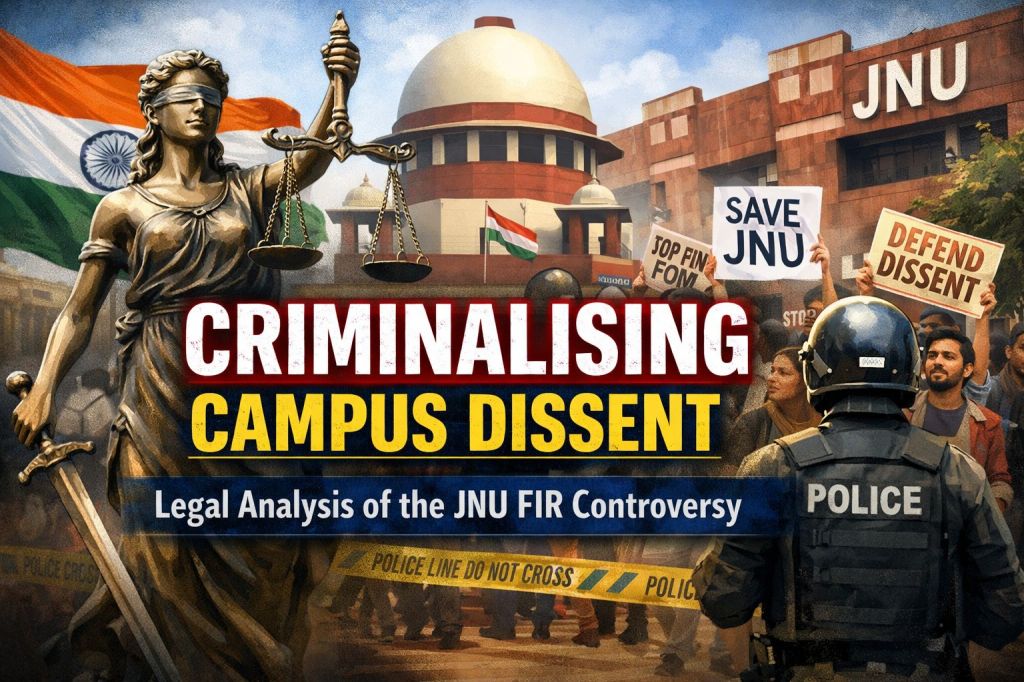
By Advocate Amaresh Yadav
Supreme Court of India
The recent action of the administration in seeking or supporting the registration of a police FIR against its own students for slogan-raising and protest activity marks a deeply troubling moment for Indian constitutionalism, academic autonomy, and the rule of law.
This is not merely an administrative overreaction; it is a constitutional misstep—one that risks transforming universities from spaces of inquiry into zones of surveillance and fear.
Universities Are Not Police Stations
A university is not an extension of the police department. It is a statutorily autonomous institution, entrusted with regulating student conduct through its own carefully designed mechanisms—Statutes, Ordinances, Codes of Conduct, and Disciplinary Committees.
By bypassing these internal processes and rushing to criminal law, the JNU administration has abdicated its primary responsibility. Courts have consistently held that specialized institutions must first exhaust their internal remedies before invoking the coercive machinery of the State.
The unavoidable judicial question will be:
If the University itself did not determine a violation through inquiry, on what legal basis was criminality presumed?
Proportionality: The Missing Constitutional Compass
The doctrine of proportionality—now firmly embedded in Articles 14, 19, and 21—demands that the State adopt the least restrictive measure to achieve its objective. Criminal prosecution is the most extreme response available to a public authority.
Here, the alleged act involves speech and expression on a university campus. The proportionate response, if any, lay in dialogue, notice, inquiry, or disciplinary proceedings. Jumping straight to an FIR is not just excessive—it is constitutionally indefensible.
Criminal law is meant to be a last resort, not the first reflex.
Misconduct Is Not a Crime
A fundamental legal error underlies the administration’s action: the conflation of academic misconduct with cognizable crime.
Every slogan, protest, or uncomfortable idea does not amount to a penal offence. Before branding students as potential criminals, the University was duty-bound to determine:
- the context of the speech,
- the intent behind it,
- and its academic or institutional impact.
Skipping this step violates principles of natural justice and the presumption of innocence. It converts an unresolved disciplinary issue into a criminal accusation—causing reputational harm that no later acquittal can fully undo.
Article 19(1)(a): The Heart of the Matter
Political and ideological speech—especially speech that critiques power structures, social hierarchies, or dominant ideologies—lies at the very core of Article 19(1)(a) of the Constitution.
Restrictions are permissible only within the narrow confines of Article 19(2): public order, incitement to violence, or other clearly defined grounds. Mere offensiveness or disagreement does not qualify.
When universities invite police action for speech-related dissent, they create a chilling effect—silencing not only those targeted, but countless others who learn to equate disagreement with criminal risk.
The Fallacy of “Contempt” and the Danger of Confusion
Equally troubling is the casual invocation of concepts such as “disrespect to court verdicts.” Criticism of outcomes, ideologies, or State policy—even after a judicial decision—does not amount to contempt of court.
Contempt is a narrowly tailored offence aimed at protecting the administration of justice, not shielding verdicts from democratic critique. Confusing dissent with contempt reflects a grave misunderstanding of constitutional law.
Police and the Academic Space: A Structural Mismatch
Police investigations are ill-suited to adjudicate questions of academic speech, ideological nuance, or campus political culture. These are matters requiring contextual and intellectual assessment, not penal scrutiny.
By inviting police intervention at the threshold, the administration has breached the constitutional buffer that protects universities as spaces of free thought and experimentation.
A Dangerous Precedent
Perhaps the most alarming consequence of this approach is the precedent it sets. If slogan-raising today invites an FIR, tomorrow any form of dissent—seminars, posters, research, debate—may be placed under the shadow of criminal law.
Universities cannot function under such constant threat. Democracy itself cannot survive if its nurseries of thought are policed into silence.
Conclusion: A Call for Constitutional Restraint
The JNU administration’s action is vulnerable on every constitutional parameter:
- it is jurisdictionally premature,
- disproportionate,
- violative of Articles 14, 19, and 21,
- and destructive of academic autonomy.
Universities must govern first, listen first, inquire first. Criminal law must remain the exception, not the norm.
As a constitutional democracy, India does not need quieter universities. It needs braver ones—and administrations courageous enough to defend dissent rather than criminalise it.
When universities fear ideas, democracy itself stands on trial.
 Amaresh Yadav
Leave a comment