Membership Without Franchise: The Democratic Question Within the Supreme Court Bar
By Advocate Amaresh Yadav
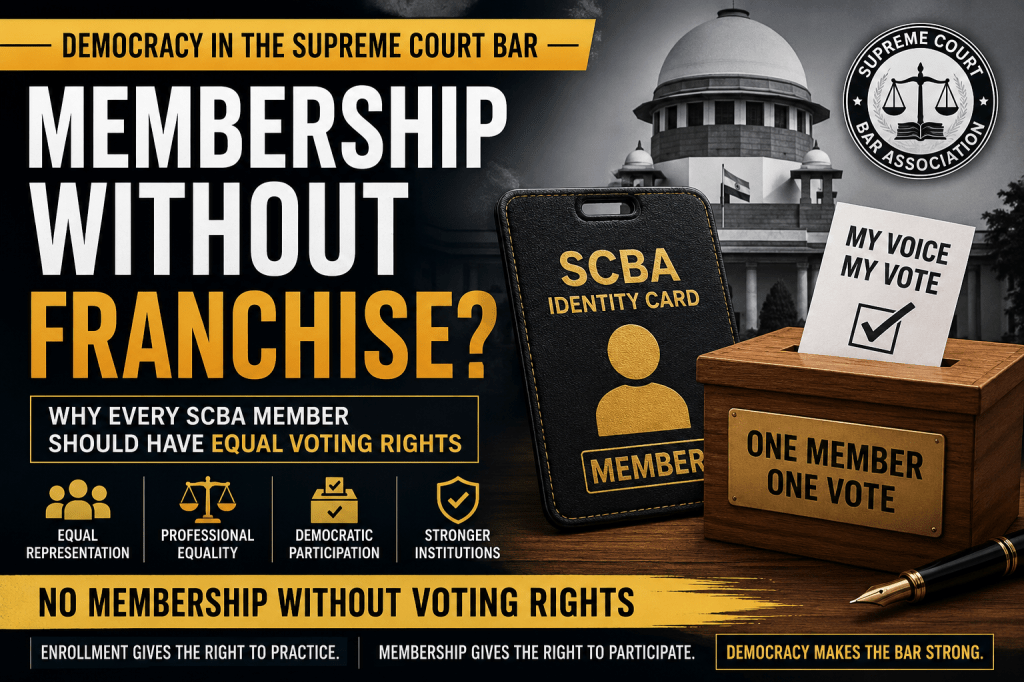
The debate surrounding voting rights within the is no longer a mere issue of bar politics. It has evolved into a larger institutional question concerning professional equality, democratic participation, and the constitutional culture of the legal fraternity itself.
At the heart of the controversy lies a simple but powerful question:
If an advocate is recognized as a member of the SCBA and issued an official membership identity card, on what constitutional or ethical basis can that member be denied voting rights?
This question deserves serious reflection.
Membership Without Voting: An Incomplete Democratic Structure
A professional association derives legitimacy from its members. When an advocate:
- pays membership fees,
- receives official membership recognition,
- holds an SCBA identity card,
- participates in bar activities,
yet remains excluded from the electoral process, a structural contradiction emerges.
Such a system creates two classes within the same association:
- members with electoral power, and
- members without meaningful democratic participation.
The principle of “one member, one vote” is a foundational democratic concept accepted across trade unions, cooperative societies, professional bodies, and representative institutions. Any departure from this principle requires transparent, objective, and constitutionally defensible justification.
The Problematic Nature of “Genuine Practitioner” Standards
One of the most commonly cited justifications for restricting voting rights is the idea that only “genuine practitioners” should participate in elections.
However, this expression raises serious concerns.
Who determines whether an advocate is “genuine”? On what objective criteria? Appearance count? Economic capacity? Chamber ownership? Registry access? Association with senior advocates?
Such standards can easily become subjective, selective, and exclusionary.
More importantly, once an advocate is duly enrolled by the and possesses a valid license to practice law, the advocate already enjoys statutory recognition as a legal professional.
If an advocate is not genuinely practicing, there exist lawful mechanisms under the Advocates Act and Bar Council rules to examine misconduct or professional inactivity. But unless the license itself is suspended or cancelled through due process, denying democratic participation within a professional association appears institutionally inconsistent.
Enrollment Is the Source of Professional Legitimacy
The legal profession in India is not governed by informal social hierarchies but by statutory enrollment.
Once a person is enrolled as an advocate:
- the right to practice flows from law,
- not from elite approval,
- chamber networks,
- procedural monopolies,
- or institutional gatekeeping.
Therefore, creating informal categories of “more legitimate” and “less legitimate” advocates within democratic structures risks undermining the equality and dignity of the profession itself.
The Concentration of Institutional Influence
The concern becomes deeper in light of the existing structure of Supreme Court practice.
Advocates-on-Record already enjoy exclusive procedural authority under Supreme Court Rules. Only they may formally file cases and act for litigants in many procedural capacities. Simultaneously, influential sections of the Supreme Court Bar also participate in the electoral and administrative structures of the SCBA.
This creates a perception among many ordinary advocates that:
- procedural power,
- electoral influence,
- and institutional access
remain concentrated within a comparatively small professional circle.
Whether or not that perception is entirely accurate, institutions must remain sensitive to such concerns if they seek democratic legitimacy.
Democracy Strengthens Institutions — It Does Not Weaken Them
Some argue that broader voting rights may dilute institutional standards or allow external political influence. Institutional discipline is indeed important. However, democratic inclusion and professional standards are not mutually exclusive.
Transparent voter criteria, verified membership systems, and ethical election processes can coexist with equal franchise.
Exclusion cannot become the default mechanism of institutional management.
A legal profession that defends constitutional democracy before courts must also remain willing to practice democratic fairness within its own representative bodies.
A Larger Constitutional Question
The issue ultimately transcends bar elections.
It concerns whether professional institutions connected closely with the administration of justice should operate through broad democratic participation or through restricted electoral structures controlled by institutional elites.
This debate is not anti-institutional. It is pro-accountability. It is pro-equality. And above all, it is a call for consistency between constitutional values and professional governance.
The principle is simple:
If an advocate is recognized as a member of the Bar, the advocate’s voice should not become conditional upon institutional privilege.
Because membership without meaningful representation risks becoming a symbolic inclusion rather than genuine democratic participation.
 Amaresh Yadav
Leave a comment