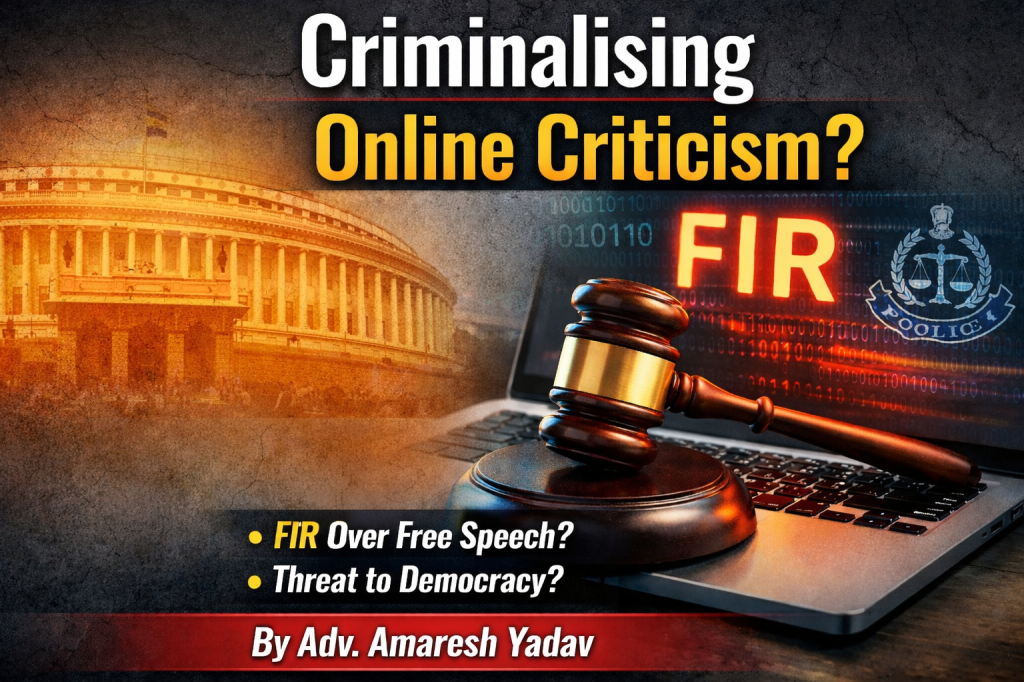
Criminalising Online Criticism: A Constitutional Appraisal of FIRs in the Rajeev Rai Episode
By Adv. Amaresh Yadav
Introduction
The increasing tendency to invoke criminal law against social media speech raises a foundational constitutional question: Where does legitimate regulation end and suppression of dissent begin?
The recent FIR registered in Mau, Uttar Pradesh—arising from online remarks concerning —offers a timely opportunity to examine this tension within the framework of Indian constitutional jurisprudence.
Factual Matrix
An FIR was lodged at Mau Kotwali on the complaint of the Member of Parliament’s private assistant against a private individual for allegedly posting derogatory and objectionable content on social media. The invocation of provisions under the Information Technology Act indicates that the dispute is rooted in digital expression, not physical conduct or traditional criminality.
Notably, the proceedings are directed against the individual user, not the public representative himself.
The Constitutional Framework: Article 19(1)(a) vs 19(2)
Freedom of speech and expression under Article 19(1)(a) is not absolute; it is subject to reasonable restrictions under Article 19(2), including defamation, public order, and decency.
However, the jurisprudence of the Supreme Court has consistently emphasized that:
- Criticism of public officials lies at the core of free speech
- Restrictions must be narrowly tailored and proportionate
- Criminal law must not become a tool for silencing dissent
The threshold for criminality, therefore, must be significantly higher than mere offensiveness or discomfort.
Judicial Position on Online Speech
In , the Supreme Court categorically held that:
“Discussion or advocacy, however unpopular, is at the heart of Article 19(1)(a).”
Only when such speech reaches the level of incitement can it be legitimately curtailed.
The present case, insofar as it pertains to allegedly “derogatory” remarks, must therefore be tested against this incitement standard, rather than subjective notions of insult.
Criminal Law and the Chilling Effect
The registration of FIRs in response to online criticism—particularly involving public figures—raises concerns of a “chilling effect”:
- Citizens may self-censor out of fear of legal repercussions
- Political accountability may diminish
- Democratic discourse risks becoming sanitised and one-sided
Criminal defamation and IT-based prosecutions, when overextended, risk transforming legal safeguards into instruments of intimidation.
Public Office and Constitutional Tolerance
Public representatives occupy a unique constitutional position. The legitimacy of their office is derived from the people, and with that comes a higher threshold of scrutiny and criticism.
It is a settled democratic principle that:
“Public figures must exhibit a greater degree of tolerance to criticism than private individuals.”
Resorting to criminal processes for reputational protection, particularly at the stage of mere allegations, must therefore be approached with institutional restraint.
Conclusion
The FIR in the present case may be legally sustainable on paper, depending on the exact content of the alleged posts. However, its broader constitutional implications warrant careful scrutiny.
The critical issue is not merely whether the law permits such action, but whether its invocation aligns with:
- Democratic values
- Proportionality doctrine
- Freedom of political expression
As India continues to navigate the complexities of digital speech, it is imperative that criminal law remains a shield against genuine harm—not a sword against dissent.
(The author is an Advocate and writes on constitutional and legal policy issues.)
 Amaresh Yadav
Leave a comment