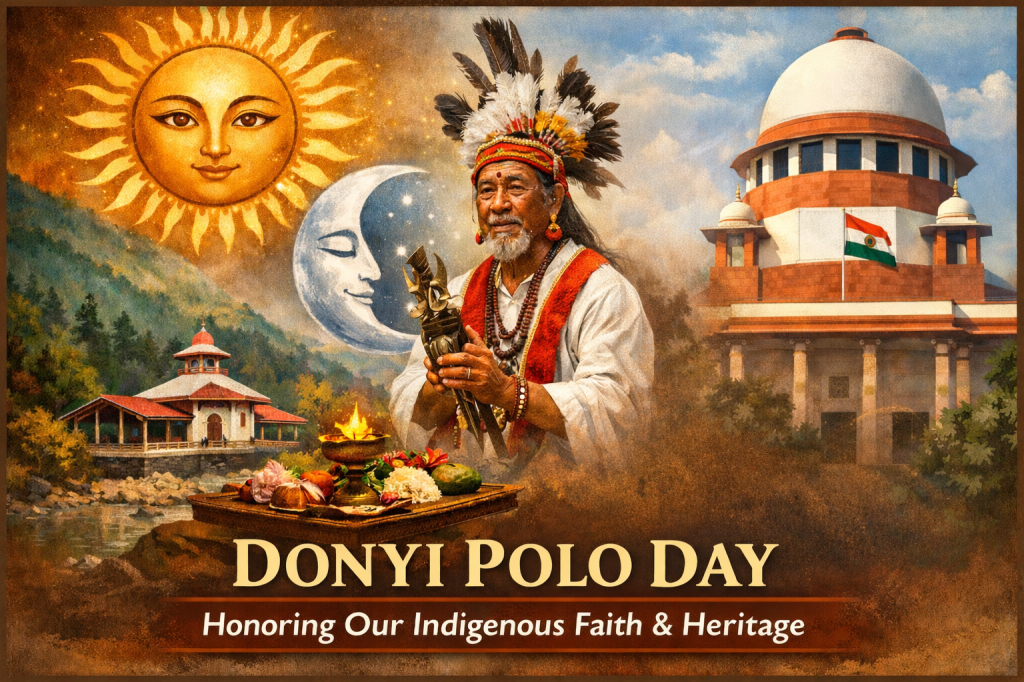
Donyi Polo Day: India’s Identity Rooted in Indigenous Civilization
By Advocate Amaresh Yadav, Supreme Court of India
India is often described as a land of faith, philosophy, colour and contradiction—but beneath this vastness runs a deeper truth: India is fundamentally an indigenous civilization.
Long before borders, scriptures, temples or empires, the people of this land lived in communion with nature, worshipped rivers as mothers, revered forests as protectors, and looked to the Sun and Moon as guardians of truth.
Among the most enduring expressions of this civilizational memory lies the Donyi Polo tradition of Arunachal Pradesh. Celebrated every year on December 31, Donyi Polo Day is not just a festival; it is the reaffirmation of India’s earliest spiritual thought—that divinity resides in nature, and nature resides within us.
Donyi Polo – A Civilizational Memory Older Than Religion
The words Donyi (Sun) and Polo (Moon) are not abstract symbols. They are the first teachers of humanity—the source of time, seasons, morality and balance. For the indigenous communities of the Eastern Himalayas:
- The Sun stands for truth, justice, and righteousness
- The Moon stands for compassion, calm, and balance
- Together, they represent the cosmic law that governs life
This worldview predates formal religions, scriptures and organized theology. It is lived, not preached. It is inherited, not converted. It is India in her oldest form.
India’s Identity Flows From Its Indigenous Roots
While India today is home to countless religions, languages and cultures, its foundation was laid by nature-worshipping, earth-rooted communities. Donyi Polo is one such pillar in the civilizational architecture of Bharat.
The tribal wisdom that shaped this belief system is the same wisdom that once shaped agriculture, medicine, water-management, community governance, and social ethics across ancient India.
To understand Donyi Polo is to understand India’s civilizational DNA.
Constitutional Recognition of Indigenous Heritage
As an Advocate of the Supreme Court, I see Donyi Polo Day as a living embodiment of:
- Article 25 – Freedom of faith and belief
- Article 29 – Protection of cultural identity of communities
- Article 51A(f) – Duty to preserve heritage
- The spirit of constitutional pluralism
India does not ask its citizens to be uniform; it asks them to be respectful.
The Constitution does not erase identity; it protects it.
Modern India Needs Indigenous Wisdom
As climate change, resource depletion and social isolation rise globally, the indigenous teachings of Donyi Polo offer answers:
✔ Nature is not a commodity, it is a relative
✔ Community stands above individual greed
✔ Spirituality is lived through harmony, not domination
✔ Culture survives through practice, not mere memory
What the world seeks today—sustainability, balance, coexistence—tribal societies have practiced for centuries.
A Call for Recognition and Respect
Donyi Polo Day must not remain limited to the Northeast—it should be recognised nationally as a testament to India’s original soul. The preservation of indigenous faiths is not just an emotional duty; it is a cultural responsibility and constitutional obligation.
On this occasion, let India remember:
We were indigenous before we were anything else.
We worshipped nature before we built monuments.
We saw gods in rivers and mountains before we carved idols.
Donyi Polo is not outside Indian civilization—
It is Indian civilization.
May the eternal Sun and Moon bless us with clarity, balance and courage—
clarity to remember where we came from,
balance to respect all faiths,
and courage to protect our roots.
Warm regards,
Advocate Amaresh Yadav
Supreme Court of India
🇮🇳🇮🇳🇮🇳🇮🇳
🇮🇳🇮🇳🇮🇳🇮🇳🇮🇳
🇮🇳🇮🇳🇮🇳🇮🇳🇮🇳🇮🇳
 Amaresh Yadav
Leave a comment