Supreme Court’s Reprimand to Allahabad High Court: A Necessary Check on Judicial Overreach
✍️ By: Advocate Amaresh Yadav
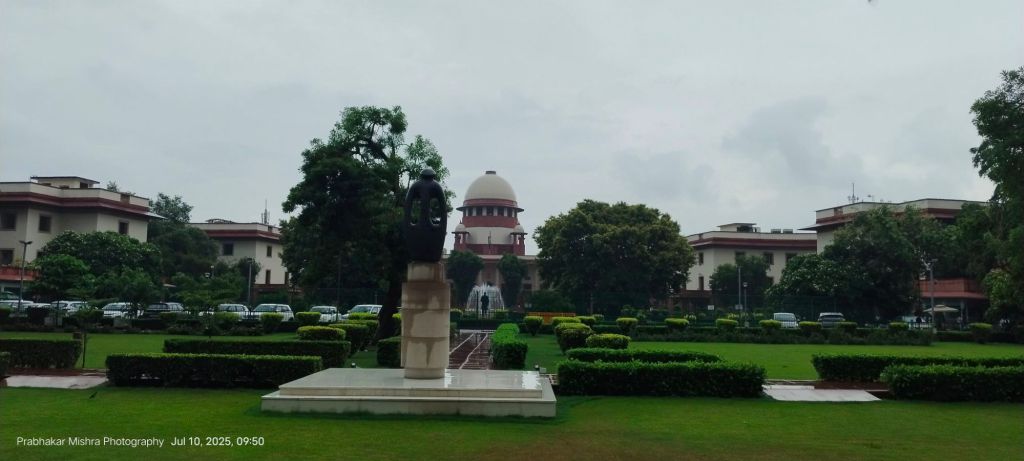
Supreme Court of India
—
In a significant ruling that reiterates the need for judicial restraint, the Supreme Court of India recently criticized the Allahabad High Court for imposing an arbitrary precondition on a litigant involved in a civil-commercial dispute dressed up as a criminal offence. This precondition—a ₹25 lakh payment to the complainant before even allowing mediation—was not only procedurally unsound, but also fundamentally violative of constitutional and criminal law principles.
The Supreme Court bench of Justices J.B. Pardiwala and R. Mahadevan strongly objected to the manner in which the High Court had transformed a civil liability dispute into a quasi-criminal settlement exercise. The top court’s observations serve as an important reminder that judicial power, however wide, is not unregulated, and must always be exercised within constitutional limits.
—
The Case: Civil Dispute Masquerading as Criminal Offence
The case concerned a film producer accused of cheating, in what was evidently a business deal gone sour. An FIR was filed under Sections related to criminal breach of trust and cheating. The accused approached the High Court seeking quashing of the FIR under Section 482 CrPC, citing the transaction as civil in nature and relying on the Bhajan Lal judgment, the gold standard on quashing criminal cases where no prima facie offence is made out.
Instead of examining the merits of the FIR or whether it disclosed any real criminality, the Allahabad High Court imposed a ₹25 lakh payment as a precondition to refer the matter to mediation—even before deciding whether the FIR itself was maintainable.
—
⚖️ Supreme Court’s Sharp Observations
The Supreme Court bench was visibly disturbed by this move. It pulled up the High Court for sidestepping the legal framework, stating unequivocally:
> “We fail to understand why the High Court should undertake such an exercise… Why should the High Court make an attempt to help the complainant to recover the amount due and payable by the accused?”
The court further noted that such conduct was not only irregular but amounted to judicial overreach, where the High Court took on the role of a civil recovery forum, bypassing legal procedure.
Importantly, the apex court reaffirmed that:
Mediation must be voluntary, not conditional upon pre-payment.
Criminal proceedings cannot be used as instruments for financial recovery.
High Courts cannot attach unrelated conditions while exercising their writ or inherent powers.
—
Revisiting Bhajan Lal: The Bedrock of Quashing FIRs
The decision echoes the spirit of State of Haryana v. Bhajan Lal (1992)—a landmark ruling that laid out the specific grounds where FIRs and criminal proceedings can be quashed. These include:
When the FIR doesn’t disclose any cognizable offence,
When allegations are absurd or inherently improbable,
When the dispute is purely civil in nature.
Despite these settled principles, the Allahabad High Court appeared to conflate civil recovery with criminal adjudication, a move rightly condemned by the apex court.
—
吝 Constitutional Boundaries: Judicial Power Must Not Be Misused
This case is more than just a legal error—it raises broader concerns about constitutional discipline within the judiciary. Courts are guardians of justice, not brokers of compromise. While facilitating resolution is commendable, imposing a financial condition without trial or findings is coercive, not judicial.
Moreover, when courts compel payments without due process, they disincentivize fair litigation and encourage misuse of criminal complaints as pressure tactics—something our judiciary has time and again warned against.
The court’s constitutional duty is to uphold the rule of law, not rewrite it for convenience or expedience.
—
High Court as Recovery Forum? A Dangerous Trend
Unfortunately, this is not an isolated incident. Increasingly, litigants have begun using FIRs in financial disputes as pressure tools, bypassing civil remedies that take time and money. Courts must be cautious not to lend legitimacy to this misuse.
The High Court, in this case, crossed a line—turning a legal remedy (mediation) into a financial condition, without examining whether the criminal case itself had any merit. This isn’t just irregular; it sets a dangerous precedent, where judicial process becomes a bargaining chip.
If such practices are allowed to persist, courts risk becoming debt recovery agents, eroding public confidence in the neutrality and constitutional integrity of the judiciary.
—
⚠️ What Mediation Is—And What It Is Not
Mediation is a valued tool of modern justice. It’s meant to foster voluntary dispute resolution, reduce court backlog, and promote amicable settlements. But mediation must remain:
Unconditional,
Voluntary, and
Free from coercive pressure.
Turning it into a tool of pre-trial punishment or economic compulsion, especially under a criminal case, undermines its entire philosophy.
—
Allahabad High Court: A Pattern of Concern?
This episode brings renewed attention to longstanding concerns about the functioning of certain benches in the Allahabad High Court. The issues raised by the Supreme Court here—improper use of discretion, judicial inconsistency, and procedural overreach—are not new.
There have been repeated murmurs in the legal community about frequent adjournments, lack of reasoned orders, and a casual approach to settled law. While the High Court, like all courts, works under immense pressure, such lapses can’t be brushed aside as anomalies.
The credibility of the judiciary depends not just on the law it applies, but the manner in which it does so—with consistency, restraint, and constitutional fidelity.
—
Supreme Court: The Constitutional Conscience-Keeper
The Supreme Court’s rebuke in this case wasn’t just a correction of an individual order—it was a reassertion of institutional boundaries.
It clarified that:
High Courts must not bypass the merit-based analysis of FIRs.
Judicial orders must be grounded in legal logic, not extralegal concerns.
Remedies like mediation must never be linked to financial preconditions without adjudication.
Through this judgment, the apex court reinstated faith in procedural fairness, reminding both litigants and lower courts that justice must flow through due process, not shortcuts.
—
茶 Final Thoughts: A Call for Judicial Restraint
As a lawyer practicing in the Supreme Court, I see this ruling not as a reprimand, but as a constructive reminder—a moment for the judiciary to reflect on how unintended judicial activism can compromise legal certainty.
Let us not forget that justice is not just about outcomes—it’s about process, fairness, and constitutionality. High Courts, powerful as they are, cannot act beyond their constitutional boundaries.
The Supreme Court has once again reminded us of the sanctity of judicial restraint and the dangers of allowing courts to slip into roles not assigned to them by the Constitution.
In the end, justice is not just about resolving disputes—it is about ensuring that those resolutions come through lawful, transparent, and principled means.
—
Advocate Amaresh Yadav
Practicing in the Supreme Court of India
 Amaresh Yadav
Leave a comment