Constitutional Boundaries and Executive Discipline: A Reminder from the Supreme Court
By Advocate Amaresh Yadav, Supreme Court of India, Delhi
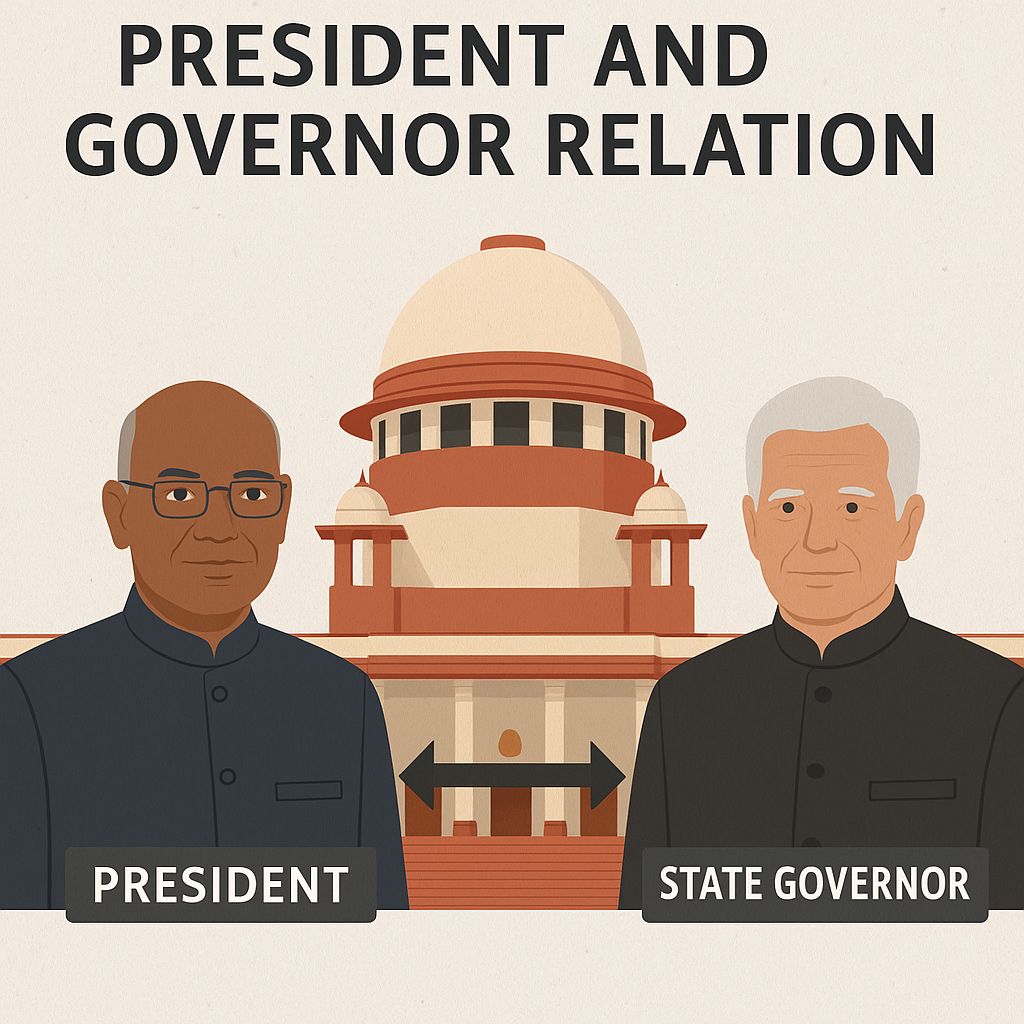
The recent judgment of the Hon’ble Supreme Court in State of Tamil Nadu v. Governor of Tamil Nadu (2025) has once again reaffirmed a foundational principle of our constitutional democracy: India is a Parliamentary system where the President and Governors are not supreme executives but constitutional heads bound by the advice of the elected government.
This decision is not just legally sound—it is an emphatic restatement of India’s democratic ethos, and a warning against creeping authoritarian tendencies cloaked in constitutional office.
The Architecture of Accountability
Dr. B.R. Ambedkar, while piloting the Draft Constitution on November 4, 1948, made it unequivocally clear that India’s system of governance is modeled on the British parliamentary system, not the American presidential form. Power, in India, flows from the people to their representatives, not to unelected appointees.
Articles 74 and 163 of the Constitution clearly mandate that the President and Governors are to act on the aid and advice of the Council of Ministers, headed by the Prime Minister or the Chief Minister, respectively. They are not to wield power at their whim or discretion, except in extremely limited and constitutionally-defined circumstances.
Misuse of Discretion: A Threat to Federalism
Recent instances have shown Governors delaying assent to Bills, withholding approvals, or even refusing to act on cabinet recommendations for extended periods. Such delays are not only morally questionable but legally indefensible. The Constitution does not grant Governors a political veto or a power of review. Their role is ceremonial and facilitative, not obstructive.
The Supreme Court’s judgment in Shamsher Singh v. State of Punjab (1974) settled this long ago, affirming that the President and Governor must act on ministerial advice. This has been consistently reiterated, including in Nabam Rebia v. Deputy Speaker (2016), where the court observed that discretion is not an escape hatch for political maneuvering.
The Deleted Schedule IV: A Historical Insight
In 1949, the Draft Constitution included Schedule IV, intended to serve as an instrument of instructions to constitutional heads. Though it was deleted by the Constituent Assembly on the argument that the text of the Constitution itself should suffice, its very proposal underscores the founders’ deep apprehension about misuse of executive posts.
T.K. Krishnamachari and Dr. Ambedkar both emphasized that any such office must remain subordinate to the will of the elected Cabinet. The deletion was not a liberalization of powers—it was an assertion that the spirit of democratic accountability must be read into every article of the Constitution.
Democratic Supremacy is Non-Negotiable
Attempts to justify gubernatorial overreach as checks and balances are not only misplaced but dangerous. The checks and balances in India operate between the executive, legislature, and judiciary—not between elected governments and unelected Governors.
Where Governors act contrary to cabinet advice, they are not upholding the Constitution; they are undermining it. In fact, such actions can border on constitutional misconduct, and may well call for reconsideration of removal mechanisms under Article 156, especially if done repeatedly or with malafide intent.
Institutional Restraint and the Way Forward
The Hon’ble President of India, Droupadi Murmu, has rightly maintained the dignity of her office by adhering to constitutional conventions. Unfortunately, not all Governors have shown the same restraint. Some have acted more as partisan agents than as neutral constitutional umpires, resulting in legal and political crises in several states.
Going forward, Parliament and the judiciary may need to explore:
- Time-bound obligations for Governors to act on Cabinet advice;
- Judicial guidelines to check delays in bill assent;
- A framework for reporting and transparency in gubernatorial decisions;
- A mechanism for civil society and parliamentary oversight of Raj Bhavan actions.
Conclusion: A Democratic Reaffirmation
The Supreme Court has, through this landmark judgment, offered a timely reminder to constitutional heads: Their office exists not above the people’s will but because of it. In a parliamentary democracy, discretion must never become disruption.
This judgment should serve not only as a precedent but also as a constitutional lighthouse guiding all public functionaries back to the shores of democratic responsibility.
Published under the name of Advocate Amaresh Yadav
Supreme Court of India, Delhi
 Amaresh Yadav
Leave a comment